RC Rover

RC Rover

Project Overview

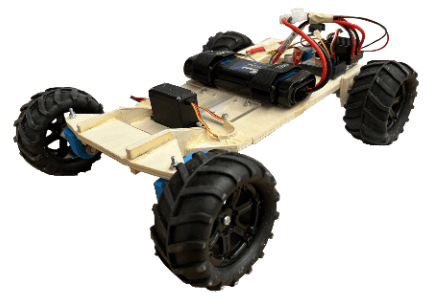
As part of a course at UCI (ENGR 7A), I developed a functional CAD model, manufactured, and drove a remote-controlled (RC) rover to meet the following requirements:

  • Must be able to navigate the obstacle course.
  • Must be free of mechanical and electrical hazards (e.g. exposed wires or gears).
  • 3D printing can only be used for the steering mechanism.
  • The rover must fit within a specified footprint and utilize only the provided electronics and hardware.

While my contributions were primarily to the CAD design, I did also assist with electrical manufacturing and became knowledgeable about all aspects of the rover.
CAD Design

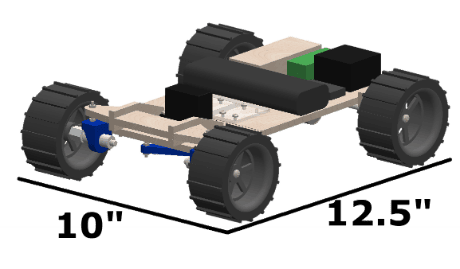
CAD model of the rover

Overview

I used Solidworks CAD to design and model the rover for this project. The chassis is constructed out of baltic birch plywood, and 3d printing was restricted to the steering mechanisms.

Key features of the RC Rover include:

  • Custom chassis design using Solidworks
  • 3D printed Ackermann steering linkages
  • Custom-made polycarbonate flexi-hinge for body-twist suspension
  • Protected gearbox housing

Design Uniqueness

The most unique design feature compared to my competitors was the twisting body design. Traditional independent or dependent suspension systems require complex manufacturing, so I designed a twisting-body layout instead. This approach keeps the drivetrain rigid while still allowing all four wheels to maintain ground contact over uneven terrain, specifically during the cone obstacle. This improved our controllability on the cones and also prevented some high-center scenarios.

The RC Rover project provided valuable hands-on experience in mechanical design, manufacturing processes, and problem-solving skills.

Final Competition

Ranking

During the final competition my rover won 4th place out of 50 teams by achieving one of the best times on the course. Many other teams experienced mechanical failures during the competition that prevented them from entering the leaderboard.

Performance Evaluation

Many teams determined that their vehicles were able to drive more effectively when facing backwards (with the steering wheels in back), but this ultimately reduced their ability to climb the ramp. Because the weight was directed away from the drive wheels, they easily lost traction and many were unable to cross the ramp obstacle.

While miscalculations in my own steering design severely limited the minimum turning radius of my rover, I decided not to drive in reverse due to the traction consequence. Instead, I was able to use carefully applied throttle adjustments to adjust the weight on the front/rear wheels to improve turning performance.